Urdu is spoken by more than 230 million people worldwide. It is the national language of Pakistan, an official language in several Indian states and a daily language for large communities in the UK, the Gulf, North America and beyond. In Britain alone, hundreds of thousands of people use Urdu at home, in mosques, in community centres and in family businesses.
That reach means Urdu appears constantly in recordings that need to be understood in English: police interviews, court evidence, immigration hearings, academic research, medical consultations and media archives. Turning those recordings into reliable English text is skilled work, and it starts with a qualified Urdu translator who can also transcribe.
Two steps, one goal
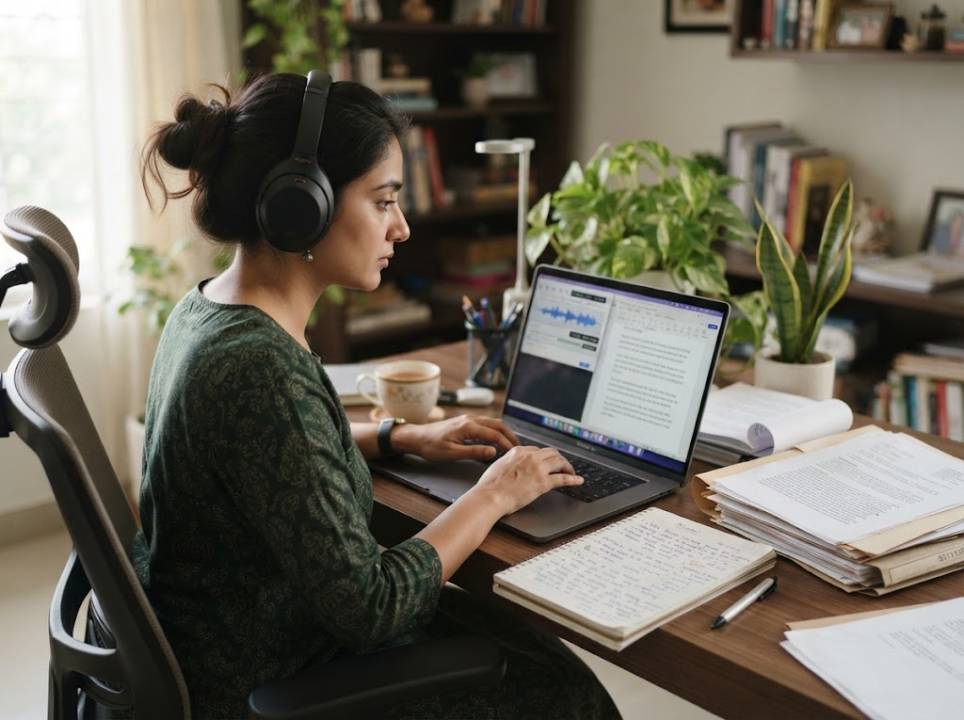
Audio projects usually involve two stages. First, the recording is transcribed in the original language, producing an accurate Urdu text with speaker labels and timestamps. Second, that text is translated into English. Some projects combine the steps, producing a direct English transcript, but evidence work often requires both versions side by side.
Keeping the original transcript allows anyone to check the translation later. In legal settings, this transparency can be decisive.
Why Urdu audio is challenging
Spoken Urdu rarely appears in a pure, textbook form. Speakers switch between Urdu, Punjabi, English and sometimes Pashto or Saraiki within a single sentence. Regional accents vary widely between Karachi, Lahore, Mirpur and Birmingham. Many British-born speakers mix English words into Urdu grammar naturally.
Recordings also tend to be messy. Phone calls with poor signal, background noise in a busy home, several people talking at once, emotional speech in interviews. A transcriber needs patience, excellent listening skills and deep familiarity with how real people speak, not just how the language is written.
Urdu script and spelling
Urdu is written in Nastaliq, a flowing form of the Perso-Arabic script, from right to left. Names and places can be transliterated into English in several ways. A careful translator follows consistent conventions and checks spellings against any official documents in the case file, so that the same person is not named three different ways in one report.
Legal and police work
Courts and police forces regularly need Urdu material transcribed and translated. Interviews under caution, intercepted calls, voice notes, video evidence and witness statements all fall into this category. Accuracy here is not just good practice. It affects whether evidence is admissible and whether people get a fair hearing.
Agencies that offer specialist legal translation services understand chain of custody, confidentiality and the need for signed statements of accuracy. Their linguists know how to mark unclear passages, overlapping speech and non-verbal sounds in a way that lawyers and judges can rely on.
Live hearings need a different skill set. In court, tribunals or police stations, qualified interpreters work in real time. Often the same case needs both: interpreters on the day and translators for the written and recorded evidence before and after.
Research and media
Universities and charities record interviews with Urdu speakers for studies on migration, health, education and community life. Broadcasters and documentary makers collect hours of footage in Pakistan and diaspora communities. All of this needs transcribing and translating before it can be analysed or subtitled.
Researchers often have specific requirements: verbatim transcripts with hesitations, or cleaned versions focused on meaning; anonymisation of names; particular file formats for analysis software. A good provider agrees these details at the start.
Healthcare
Hospitals and clinics also produce Urdu recordings, for example in patient interviews, mental health assessments or research on access to care. Written patient information, discharge letters and consent forms may need translation into Urdu too. For this work, medical translation services bring the clinical knowledge needed to handle terminology safely and sensitively.
Standards and qualifications
In the UK, many professional linguists hold qualifications or membership with bodies such as the Chartered Institute of Linguists. For legal work, look for translators who are experienced with court and police requirements and can provide signed declarations. For research, look for clear data protection practices and the ability to work with consent and anonymisation rules.
How to prepare an audio project
- Send the best quality recording available, ideally the original file
- Explain who is speaking and roughly how many speakers there are
- State whether you need verbatim or clean transcription
- Say if you need Urdu transcripts, English translation or both
- Agree on timestamp intervals and file format
- Share names, places and terms that may come up
Time and cost
Transcription is usually priced per audio minute, translation per word. Difficult audio with heavy noise, many speakers or mixed languages takes longer. As a rough guide, one hour of clear audio can take several hours to transcribe accurately, and more to translate. Planning ahead avoids rushing, which is when errors creep in.
Why machine tools are not enough
Automatic speech recognition for Urdu has improved, but it still struggles with accents, code-switching and poor recordings. It cannot sign a declaration of accuracy, and it has no way of judging what an unclear word should be in context. For anything that matters legally, medically or academically, human expertise is the only safe option.
Giving every voice its weight
Behind every recording is a person whose words deserve to be understood exactly as they were spoken. A skilled Urdu translator and transcriber makes sure nothing is lost, softened or invented along the way. Whether the setting is a courtroom, a hospital or a research study, that accuracy protects people and supports better decisions.